Table of Contents
Understanding Tree Trimming Costs
As homeowners face growing concerns over safety and property aesthetics, the demand for professional tree care has surged. Overgrown branches from a suburban oak, for instance, can pose risks to homes and power lines, making timely trimming essential. The tree trimming cost typically ranges from $200 to $1,000 per tree nationally, depending on various factors that influence pricing.
Tree trimming, also known as pruning, involves selective cutting to maintain health and shape. This includes crown reduction to lessen height and weight, deadwood removal for safety, and crown raising to clear space beneath branches. When asking ‘how much does tree trimming cost,’ consider that small trees under 25 feet often run $150 to $450, while larger ones demand more due to equipment needs. Tree maintenance pricing varies by region, with hourly arborist service fees averaging $50 to $100, higher in urban areas with access challenges. Key cost drivers include:
- Tree size and height: Taller trees require specialized gear.
- Location and accessibility: Urban sites with obstacles increase labor.
- Complexity and species: Dense or resilient woods add time.
This guide demystifies budgeting for tree care, starting with fundamentals, then exploring pricing drivers, practical tips, advanced considerations, and FAQs. Our free cost calculator delivers instant, personalized estimates based on your tree details, helping you prepare for quotes without surprises.
Connecting with local certified arborists ensures accurate assessments and value-driven services. Upcoming sections will equip you to evaluate options confidently, turning potential expenses into smart investments for your property’s well-being.
Tree Trimming Fundamentals
To start budgeting effectively, grasp these core factors in tree trimming. Tree trimming involves selectively cutting branches to maintain shape, health, and safety, while pruning focuses more on targeted removal for growth promotion or disease control. Basic services include deadwood removal to prevent hazards, crown lifting to raise lower branches for clearance, and crown thinning to improve air flow and light penetration. These fundamentals help homeowners address routine maintenance without unnecessary expenses.
Understanding service definitions is key to selecting the right care. For instance, basic pruning targets diseased or rubbing branches, while crown reduction shortens overly long limbs. When tree service selection guide, evaluate if entry-level tree care pricing covers these essentials or if specialized work is needed. Bullet points outline common types:
- Deadwood removal: Eliminates broken or dying branches, typically quick and low-cost.
- Crown lifting: Cuts lower limbs for driveway or sidewalk access, ideal for small trees.
- Crown thinning: Reduces density to prevent storm damage, balancing aesthetics and structure.
These services form the foundation, ensuring trees thrive in residential settings.
Tree size plays a pivotal role in determining Tree Trimming Cost, as larger specimens require more time, equipment, and labor. Small trees under 25 feet often need basic access, keeping expenses modest, while medium and large ones demand extensive reach, driving up rates. Homeowners frequently ask how much does tree trimming cost for different sizes, with national averages around $652 per job according to HomeAdvisor data.
The following table provides a clear comparison of average costs based on tree size, incorporating service types and durations to aid quick budgeting:
| Tree Size | Average Cost Range (USD) | Service Type Included | Typical Duration |
|---|---|---|---|
| Small (under 25 ft) | $150-$300 | Basic pruning and deadwood removal | 1-2 hours |
| Medium (25-50 ft) | $300-$700 | Crown thinning and raising | 3-5 hours |
| Large (over 50 ft) | $700-$1,200 | Full crown reduction | 6+ hours |
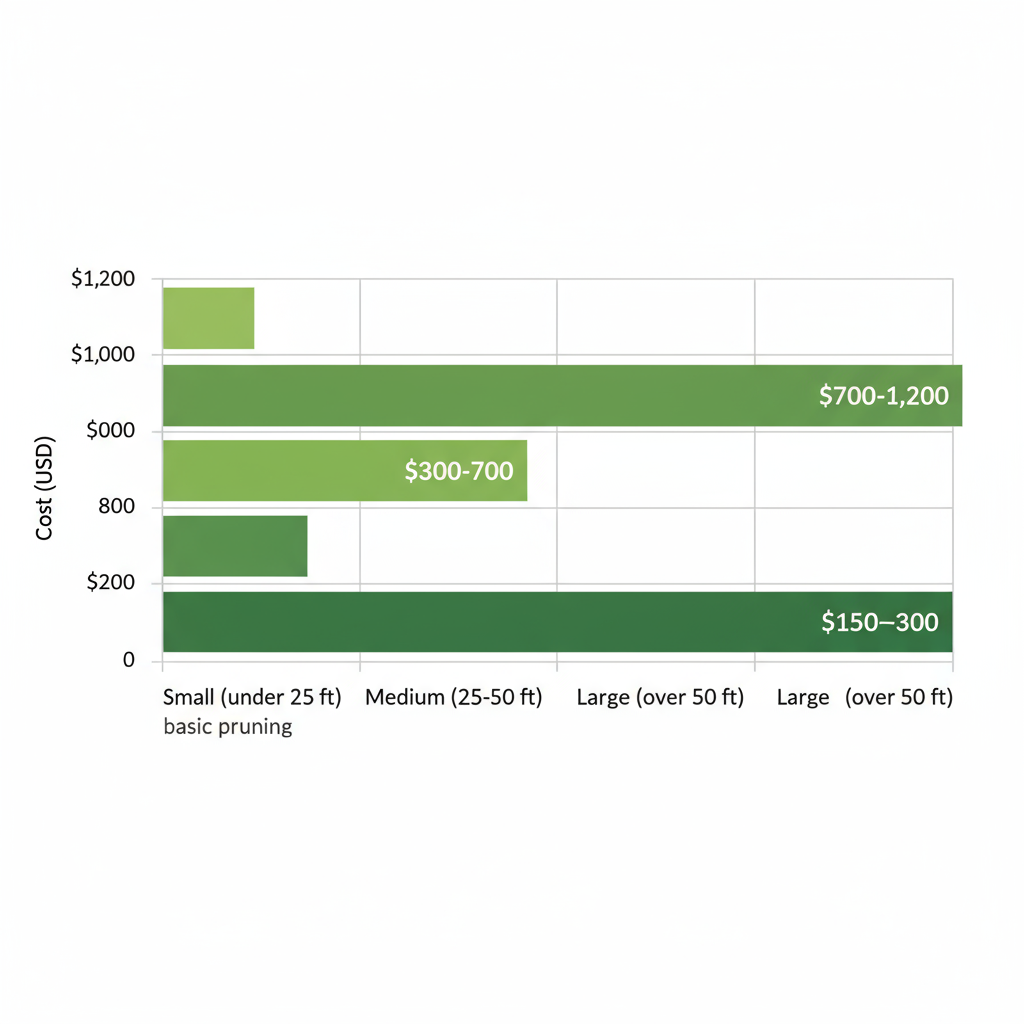
Average tree trimming costs by tree size categories
This data, drawn from national averages, shows how size escalates tree pruning costs due to safety measures and tools; small trees suit DIY or basic arborist fees, but large ones often hit $500+, varying 20-30% by region. For multiple trees, budget by scaling: a yard with two medium oaks might total $600-$1,400, factoring cleanup. Use site tools for precise estimates to avoid surprises.
If space allows, consider pricing models like hourly rates of $50-$150 versus flat fees. Hourly suits variable jobs under 2 hours, while flat fees streamline standard trims averaging $652 nationally. Regional factors influence these, with urban areas like California adding 25% premiums over Midwest flatlands due to access challenges and regulations. Species matter too: softwoods like pine trim easier and cheaper than hardwoods like oak, which resist cuts and demand skilled handling. When choosing tree trimming service, prioritize certified arborists for quotes, especially in high-cost zones, to ensure value. Basic services suffice for healthy, accessible trees, but advanced issues like decay signal deeper needs explored later.
While these fundamentals cover routine upkeep, complexities like site access and health assessments demand further exploration in upcoming sections.
Deep Dive into Pricing Factors
While basic tree trimming costs provide a starting point, understanding the key variables that influence final quotes is essential for accurate budgeting. These Tree Trimming Cost drivers, such as site conditions and tree characteristics, can add hundreds to the bill, helping users anticipate expenses from professional arborists.
Factors Influencing Tree Trimming Costs
Several elements directly impact tree trimming expenses, starting with site access challenges. In urban settings versus rural areas, proximity to power lines or buildings can increase costs by $200 or more, as noted in Angi resources, where such hazards demand specialized equipment and safety measures. For selecting tree trimming service providers experienced in complex sites, this ensures safer and more efficient work.
Tree species play a significant role too. According to Vevor guides, evergreens like pine are cheaper to trim due to softer branches, adding $0 to $150, while dense hardwoods such as oak can raise prices by $300 to $600 because of tougher pruning needs. Branch complexity further varies quotes; simple deadwood removal stays low, but intricate jobs like heavy shaping require advanced skills.
Labor rates, typically $75 to $150 per hour, and equipment like lifts add to these. Debris removal options range from basic haul-away at $50 to $150 up to full restoration at $200 to $400. These tree care expense drivers allow for better planning.
Pricing variability arises from how these factors interact with base rates. The following table illustrates adjustments based on national surveys:
| Factor | Low Impact Example | Cost Adjustment (USD) | High Impact Example |
|---|---|---|---|
| Site Access | Easy backyard, flat terrain | +0-$100 | Steep slope or near structures (+$200-$500) |
| Tree Species | Pine (softwood), easy pruning | +0-$150 | Oak (hardwood dense branches) (+$300-$600) |
| Complexity | Simple deadwood, routine maintenance | +0-$200 | Heavy crown reduction (+$400-$800) |
| Debris Cleanup | Minimal removal, basic haul-away | +50-$150 | Full site restoration (+$200-$400) |
Total costs equal base plus these factors; consult local arborists for precise quotes. To mitigate high impacts, prioritize early assessments and bundle services, potentially saving 10-20% through negotiation.
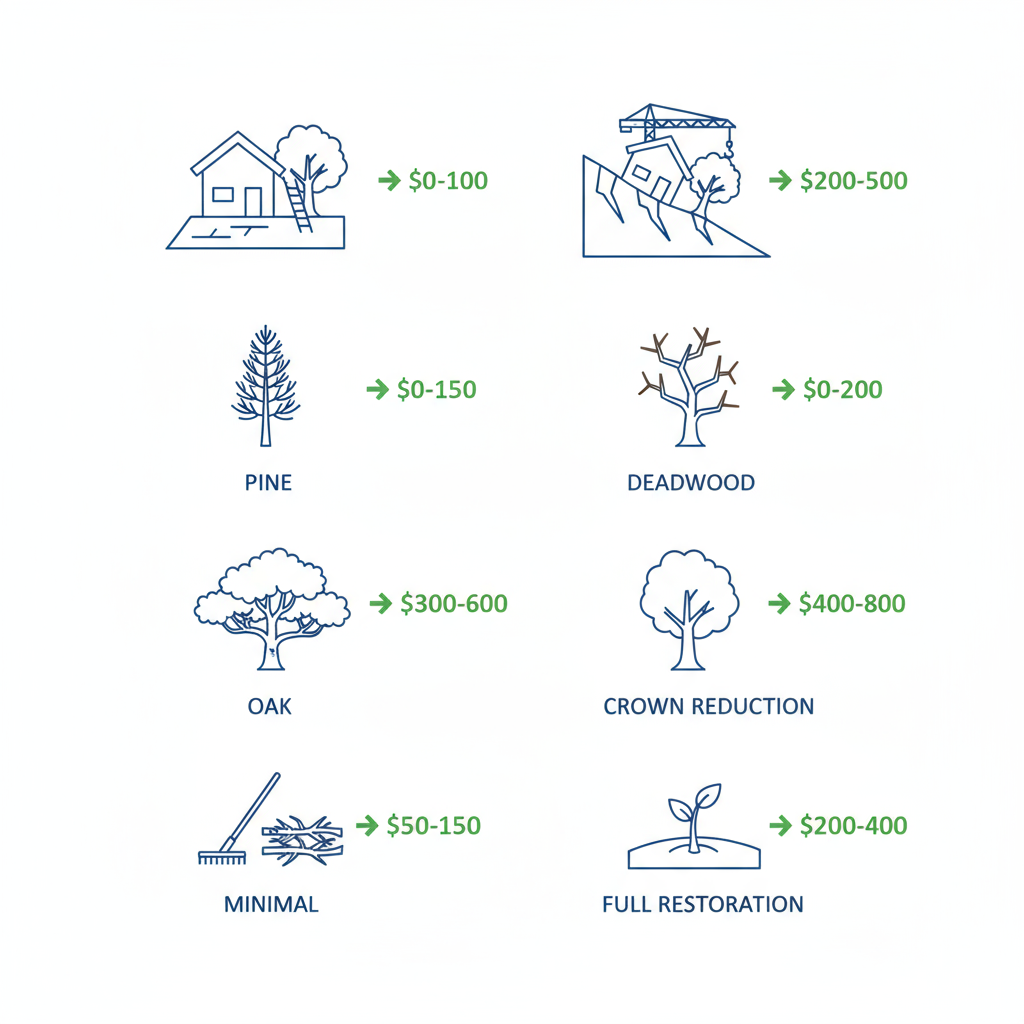
Key factors influencing tree trimming costs illustrated
Service-Specific Cost Variations
Different techniques alter tree pruning costs significantly, with basic thinning starting at lower rates compared to advanced crown reduction. Basic thinning, which removes select branches for airflow, typically costs $200 to $500 for medium trees, involving standard tools and 2-4 hours of labor.
In contrast, crown reduction shortens tree height for safety or aesthetics, demanding cranes or climbers, pushing prices to $500 to $1,200. Equipment like chippers adds $100 to $300, while skilled labor for precise cuts ensures health. For choosing reliable tree service in high-risk jobs, vetting certified pros reduces errors and extra fees.
Deadwood removal remains affordable at $100 to $300, focusing on safety without major reshaping. These variations stem from time and risk; for instance, a large tree’s crown work might double basic fees due to complexity.
The table below compares common services, drawing from reference data for accuracy:
| Service Type | Description | Average Cost (USD) | Labor/Equipment Impact |
|---|---|---|---|
| Basic Thinning | Selective branch removal | $200-$500 | Standard tools, 2-4 hrs |
| Crown Reduction | Height/width reduction | $500-$1,200 | Cranes/climbers, 4-8 hrs |
| Deadwood Removal | Hazardous limb excision | $100-$300 | Saws/ladders, 1-3 hrs |
| Crown Raising | Lower branch clearance | $150-$400 | Basic access, 2-5 hrs |
Opt for tailored services to match needs, consulting arborists for quotes that reflect these specifics.
Regional and Seasonal Pricing Dynamics
US regions shape arborist pricing variables through climate and demand. Coastal areas like California see higher rates at $400 to $800 due to regulations and access issues, versus inland Midwest at $250 to $600 for simpler terrains.
Seasonal timing offers savings; Plant Calculators note winter trimming cuts 15% off peak summer prices, ideal for dormant trees in the Northeast. For tree trimming provider selection, choose certified pros for off-peak services to maximize discounts while ensuring safety.
With these insights, apply them to real budgeting in the next section.
Practical Tree Trimming Budgeting
Effective budgeting for tree trimming ensures you maintain healthy landscapes without overspending. Start by assessing your property’s needs, then factor in Tree Trimming Cost estimates to create a plan that balances quality and affordability. This approach helps answer key concerns like how much to allocate and what influences overall expenses.
Building a Realistic Budget for Tree Care
Assess your trees’ condition first to determine the scope of work. Measure tree height, diameter, and any hazards like overhanging branches near structures. Use online tools to input these details for initial Tree Trimming Cost projections that reflect base rates starting at $200 for small jobs.
Next, gather at least three quotes from local professionals to compare pricing structures. Consider per-hour rates, often $50 to $150 depending on how much does tree trimming cost per hour?, versus fixed project fees that provide predictability for larger tasks. Factor in add-ons such as stump grinding or cabling, which can add 20-30% to totals, and regional adjustments–for instance, urban areas like California may increase costs by 15% due to access challenges.
Build your budget with these steps:
- Estimate base costs using average data from sources like HomeAdvisor, where routine trimming ranges $200-$500.
- Add buffers for unexpected issues, such as 20% for soil conditions or permits in the Midwest.
- Include cleanup fees, typically $100-$300, especially for properties with strict HOA guidelines.
Incorporate tree service choice factors like certifications and insurance when evaluating bids to avoid low-ball offers that compromise safety. Aim for multi-tree discounts, which can save 10-15% on bundled services. This practical arborist budgeting method positions you for informed decisions, contextualizing value against questions like “Is tree trimming expensive?” by highlighting long-term savings on tree health.
When choosing between trimming and pruning, consider the distinct benefits each offers. Basic trimming focuses on quick safety clearances, while pruning enhances structure and prevents disease. The following table outlines these options to guide your selections:
| Service Type | Average Cost (USD) | Benefits | When to Choose |
|---|---|---|---|
| Basic Trimming | $200-$500 | Quick maintenance, safety focus; Routine branch clearing | Overgrown but healthy trees |
| Pruning (Crown Thinning) | $300-$700 | Improves structure, airflow; Disease prevention | Mature trees needing shaping |
| Crown Reduction | $500-$1,000 | Reduces height/weight safely; Storm risk reduction | Large, unstable branches |
| With Debris Cleanup | + $100-$300 | Site restoration included; Full service package | Properties with HOA rules |
Opting for comprehensive services like crown reduction delivers strong ROI through reduced storm damage risks, potentially saving thousands in emergency removals. Industry data shows that investing in pruning now can cut future tree pruning costs by up to 25% via proactive health maintenance. Tailor your budget to these insights for optimal value.
Seasonal Timing and Cost Savings Strategies
Timing your tree trimming aligns with natural growth cycles to lower Tree Trimming Cost while promoting vigor. In the US, dormant seasons–fall and winter–offer prime windows, as trees heal faster post-work and providers face less demand, yielding 10-20% savings per Plant Calculators data.
For Northeast climates, schedule fall trimming after leaf drop to minimize stress on maples and oaks. Midwest regions benefit from winter sessions, avoiding summer heat that stresses evergreens like pines. In the Southwest, late winter targets cacti-like species to prevent sap flow issues, while Pacific Northwest pros recommend early spring for firs to dodge wet-season hazards.
Strategies to maximize savings include:
- Booking off-peak: Avoid spring growth surges when rates peak 15-25% higher.
- Bundling with seasonal maintenance: Combine with leaf removal for package deals.
- Monitoring local weather: Trim post-frost in colder zones to ensure accessibility.
These practices answer “What factors influence tree trimming cost?” by leveraging timing to control expenses. Use site calculators for zone-specific estimates, ensuring healthy outcomes without premium pricing.
The table below compares seasonal impacts on costs:
| Season | Average Cost Savings | Best For Climate Zones |
|---|---|---|
| Fall/Winter | 10-20% | Northeast, Midwest (dormant periods) |
| Spring | 5-10% | Pacific Northwest (pre-growth) |
| Summer | Full price | Southwest (limited, high-risk windows) |
Prioritizing dormant timing not only trims budgets but enhances tree resilience against pests and storms.
Getting Quotes from Certified Arborists
Begin by identifying certified arborists through vetted platforms to ensure expertise. Request at least three quotes, detailing tree specs, access points, and desired outcomes like crown raising or deadwood removal.
Evaluate bids using criteria such as ISA certification, liability insurance, and references–practical arborist budgeting demands transparency to sidestep subpar work. Compare per-project totals against hourly rates, watching for hidden fees; HomeAdvisor notes that multiple quotes reduce overpayment by 15%.
Connect via this site’s tools for immediate referrals to local pros. Follow the tree trimming service guide for streamlined processes, including checklists for discussions. Warn against suspiciously low bids, which may indicate unlicensed operators risking fines or rework costs. This methodical approach accelerates reliable project starts.
Advanced Tree Care Considerations
For tougher tree maintenance tasks, advanced considerations significantly influence overall tree trimming costs. These include safety protocols, specialized equipment, and high-risk scenarios such as urban environments or hazardous sites near power lines. Homeowners facing complex jobs must budget for these elements to ensure professional outcomes and avoid liabilities.
Safety remains paramount in advanced tree care, often adding $100 to $500 for gear and OSHA compliance. Certified arborists charge about 20% more than standard crews, as noted by industry surveys, but this premium reduces liability risks substantially. For instance, trimming near utility lines requires insulated tools and ground crew coordination, elevating the tree trimming cost due to potential hazards. Essential safety tips include:
- Always hire ISA-certified professionals for elevated risks.
- Conduct pre-job site assessments to identify unstable branches.
- Use barriers to protect property and bystanders from falling debris.
These protocols prevent accidents, justifying the investment in expertise. When equipment like cranes is needed for tall or obstructed trees, specialized tree maintenance expenses rise quickly; crane rental alone can hit $200 per hour according to equipment guides.
The following table provides a comparison of advanced service costs, highlighting base prices, add-ons, and safety factors for informed planning.
| Advanced Service | Base Cost (USD) | Add-Ons | Safety Factors |
|---|---|---|---|
| Crown Raising for Clearance | $400-$800 | Utility line proximity (+$200), OSHA compliance checks | Height access equipment, N/A |
| Deadwood Removal in Canopy | $300-$600 | Aerial inspection (+$150) | PPE and training req., Risk of falling debris, N/A |
| Full Crown Thinning | $500-$900 | Species-specific tools (+$100) | Structural integrity assess., High-wind zone premiums, N/A |
This table underscores the complexities of advanced services, where add-ons for access or inspections can increase totals by 30-50%. Mitigation strategies, like scheduling during low-wind seasons or opting for full structural assessments upfront, help control these costs while enhancing tree health. Advanced costs are typically 40-60% higher due to required expertise, making certified arborists essential for quality results.
Species-specific advanced care further impacts tree pruning costs, especially for fruit trees needing precise cuts to promote fruiting without disease entry. Local codes may mandate permits for work over 15 feet, adding compliance fees of $50-$200. Opt for full assessments when trees show signs of decay, as early intervention prevents costly removals later.
Consider a case in an urban setting: A 50-foot oak near power lines required crown reduction, costing $1,200 including crane and utility coordination–far above basic jobs but essential for safety. Another example involved deadwood removal in a high-wind zone, at $750 with aerial checks, averting potential storm damage. These scenarios illustrate how professional tree pruning costs vary, often answering queries like “How much does professional tree pruning cost?” or “What is the cost of crown reduction?” For more on these advanced queries, see the FAQ section.
Common Tree Trimming FAQs
How much does tree trimming cost? On average in the US, Tree Trimming Cost ranges from $400 to $700 for standard jobs, per Angi insights. Larger trees push expenses to $800 or more due to added complexity and equipment.
How much does tree pruning cost? Tree pruning costs typically fall between $300 and $800, depending on tree size and health. This service focuses on structural integrity, similar to trimming pricing structures.
Is tree pruning cheaper than tree trimming? No major difference; both average around $400-$700. Pruning addresses structural issues while trimming enhances aesthetics, but costs align closely based on scope.
How much does tree trimming cost per hour? Hourly rates average $75, ranging $50-$100 per Angi data. Full jobs often use flat fees for predictability.
What is the difference between tree trimming and pruning? Trimming is cosmetic for shape and health; pruning removes dead or hazardous branches structurally. Costs overlap, emphasizing professional assessment.
How much for crown reduction? Expect $500-$1,000 for crown reduction, reducing height safely. It’s value-driven for safety and aesthetics.
Budgeting tips for tree trimming? Add a 10-20% buffer to estimates. Follow tree trimming selection tips for cost-effective planning.
How to choose a professional service? Opt for a reliable tree trimming service with certified arborists to ensure quality and fair pricing.
Key Takeaways on Tree Trimming Expenses
Understanding Tree Trimming Cost is essential for effective budgeting, with averages ranging from $200 to $1,200 based on tree size. Key factors like site access, seasonal timing, and the distinction between tree trimming and pruning directly influence how much does tree trimming cost. Hiring certified arborists ensures safety and delivers overall savings of 20% compared to DIY efforts, as validated by industry experts.
- Budget Strategically: Factor in complexity and debris cleanup for accurate quotes.
- Maximize Value: Prune during dormant seasons to reduce tree pruning costs and promote health.
- Prioritize Professionals: Referrals provide reliable estimates and compliance.
Armed with this guide, get your personalized estimate using our calculator and connect with a certified arborist today for seamless, cost-effective tree care.