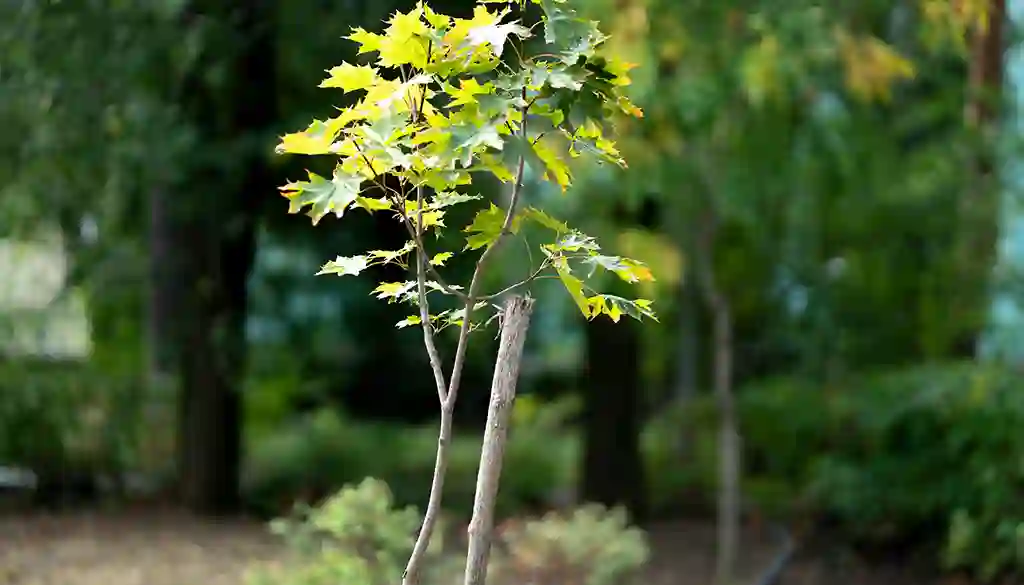
Training young trees requires strategic pruning during the first 5-8 years to establish proper branch structure, eliminate weak unions, and create strong frameworks that last decades.
Start training at planting. Remove competing leaders immediately. Prune annually during dormancy. Focus on establishing a central leader, eliminating co-dominant stems, spacing lateral branches 12-18 inches vertically, and removing branches with narrow crotch angles under 45 degrees.
Most homeowners plant trees and ignore them for years. Then problems appear—multiple trunks competing, branches crossing and rubbing, weak attachments that split under stress. By then corrections cost hundreds or thousands and leave permanent wounds. Training prevents these issues when trees are small and fixes are cheap.
Use treetrimmingcostcalculator.com to estimate costs for professional structural training services. Input your tree count, species, and ages. The calculator provides annual training costs helping you budget across the critical early years when structural investment pays the highest returns.
Why Young Tree Training Actually Matters
Mature tree structure depends entirely on decisions made during the first decade. Poor structure can’t be fixed later—only managed expensively. A tree developing co-dominant stems at age 3 costs $100-$150 to correct. That same tree at age 15 with 8-inch co-dominant stems costs $800-$1,500 to correct and leaves massive wounds that never fully heal.
Trees grown without training develop naturally but natural doesn’t mean strong. Forest trees grow in dense competition producing tall straight trunks with minimal branching. Landscape trees grow in open conditions producing multiple leaders, low branches, and structural problems. Natural landscape growth creates weak trees prone to storm damage and early failure.
Proper training builds trees that resist storm damage. Well-structured trees flex in wind rather than breaking. Properly spaced branches distribute weight evenly. Strong unions withstand ice loading. The difference between trained and untrained trees shows most clearly after major storms—trained trees stand while untrained trees split and fail.
Property values depend on tree quality. Well-structured mature trees add $3,000-$10,000 to property values. Poorly structured trees decrease values and create liability concerns. Structural training protects your landscaping investment long-term.
When to Start Training Young Trees
Begin at planting. Nursery trees often arrive with structural problems—multiple leaders, poorly spaced branches, damaged limbs from handling. Address these immediately before the tree establishes in its new location.
Year one focuses on establishment not major pruning. Remove only broken branches, competing leaders, and branches rubbing the trunk. The tree needs maximum foliage to photosynthesize and establish roots. Heavy pruning the first year stresses newly planted trees and slows establishment.
Years two through five represent the critical training window. Trees grow rapidly but branches remain small enough for easy corrections. Establish central leader dominance. Set permanent scaffold branch framework. Eliminate structural problems before they become expensive. Annual training sessions during this period cost $75-$200 per tree but prevent thousands in future corrective work.
Years six through eight involve lighter maintenance pruning. The structural framework exists. Training focuses on maintaining leader dominance, removing problematic growth, and reinforcing good structure. Frequency can decrease to every other year for slow-growing species.
Most training programs span 6-8 years total. After that trees transition to standard maintenance pruning on 3-5 year cycles. The structural investment is complete. Future pruning maintains health and manages size rather than correcting fundamental architecture.
Establishing Central Leader Dominance
Trees with Single central leader dominance develop stronger structure than multi-leader trees. The central leader grows vertically becoming the main trunk. Lateral branches remain subordinate. This creates the strongest most storm-resistant form for most species.
Identify the strongest most vertical shoot as the leader. Remove or subordinate all competing leaders. Competing leaders are shoots growing at similar angles and vigor as the chosen leader. They create weak unions that split under stress.
Remove small competing leaders completely. For larger competing leaders that are too big to remove without excessively stressing the tree, subordinate them instead. Subordination means cutting the competing leader back by one-third to one-half its length. This slows its growth while maintaining some foliage. Over 2-3 years the subordinated stem becomes clearly less dominant and can be removed entirely.
Some species naturally produce multiple leaders. Birches, dogwoods, and some maples grow as multi-stem trees naturally. For these species, accept multiple leaders but ensure they originate from ground level or very low on the trunk. Multiple leaders higher on the trunk create weak unions regardless of species.
Leader dominance requires maintenance. Each year new shoots emerge trying to compete with the leader. Annual pruning removes these competitors maintaining clear leader dominance. Skip a few years and competing leaders establish requiring expensive corrections.
Spacing and Selecting Scaffold Branches
Scaffold branches form the tree’s permanent framework. These are the major limbs that define the tree’s mature form. Proper selection and spacing of scaffold branches prevents future problems.
Vertical spacing matters significantly. Scaffold branches should be 12-18 inches apart vertically for small to medium trees and 18-24 inches apart for large shade trees. Branches too close together create weak areas and compete for resources. This spacing ensures each scaffold develops independently with room to grow.
Radial distribution prevents lopsided growth. Scaffold branches should distribute evenly around the trunk creating balanced form. Avoid having multiple scaffolds emerging from the same side of the trunk. Ideally scaffolds spiral around the trunk as you move up creating even weight distribution.
Branch angle determines strength. Branches emerging at 45-60 degree angles from the trunk develop the strongest attachments. Branches at narrow angles under 45 degrees create weak unions prone to splitting. Branches at very wide angles near 90 degrees lack sufficient attachment strength. Select scaffolds with proper angles and remove branches with poor angles.
Branch diameter ratios indicate proper subordination. Scaffold branches should be no more than one-half to two-thirds the diameter of the trunk at their attachment point. Branches approaching trunk diameter in thickness compete with the leader and create weak unions. Remove or subordinate branches growing too thick relative to the trunk.
Most trees need 5-8 permanent scaffold branches establishing the mature framework. More than this creates crowded canopies. Fewer leaves canopies too sparse. The exact number varies by species and intended mature form.
Removing Problematic Growth Types
Several growth types require removal during training regardless of location or timing.
Watersprouts are vigorous vertical shoots growing from branches or trunk. They grow rapidly but attach weakly and rarely develop into quality branches. Remove all watersprouts annually. Leaving them wastes the tree’s energy on useless growth.
Suckers are shoots emerging from roots or trunk base. They compete with the main tree for resources and create messy appearance. Remove suckers at their origin point. Cutting them at ground level leaves buds that resprout. Dig down and remove suckers where they emerge from roots or trunk.
Crossing branches rub against each other creating wounds that invite disease and insects. Remove one of the crossing branches—typically the smaller or more poorly positioned one. Don’t wait for damage to appear. Remove crossing branches as soon as you identify them.
Included bark forms when two branches or stems grow so close together that bark gets trapped between them instead of forming proper wood connection. This creates extremely weak unions that fail under minimal stress. Remove one of the stems with included bark immediately. These unions only worsen with time.
Codominant stems are two or more stems of similar size growing upward from the same point. They create weak unions that split. Remove all but one stem or if removal is too severe, subordinate competing stems by cutting them back significantly.
Branches with bark wounds, disease signs, or insect damage get removed regardless of position. Damaged branches don’t recover and spread problems to healthy wood. Early removal prevents disease progression.
Correcting Branch Angle Problems
Branch attachment angle determines long-term strength. Training involves both removing branches with poor angles and sometimes correcting angles of important branches.
Narrow crotch angles under 45 degrees create weak attachments. The bark often gets included in the union rather than forming proper wood connections. These branches split under relatively light loads. Remove branches with narrow crotches during training. Don’t try to save them—they’ll never develop strong attachments.
For young branches with slightly narrow angles that you want to keep, spreaders sometimes help. Spreaders are physical devices that push branches away from the trunk widening the angle. Simple spreaders include notched wood pieces, spring-loaded spreaders, or weighted attachments. Install spreaders for one growing season. The branch maintains the wider angle after spreader removal. This only works on branches under 1-2 inches diameter. Larger branches won’t respond to spreading.
Excessively wide angles near 90 degrees also lack strength. Branches grow more horizontally than vertically and attach weakly. Remove branches with excessively wide angles or subordinate them to secondary status rather than scaffold branches.
Proper 45-60 degree angles need no correction. These branches develop strong wood connections naturally and support heavy loads throughout the tree’s life.
Pruning Timing and Techniques for Training
Late winter during dormancy provides optimal training timing. Trees aren’t actively growing so pruning stress is minimal. Bare branches make structural evaluation easy. Wounds begin healing immediately when spring growth starts. Most training pruning happens January through March depending on climate.
Summer training sometimes makes sense for specific situations. Watersprout removal happens in summer because dormant pruning stimulates excessive sprouting. Diseased branch removal happens whenever disease appears regardless of season. Some species like maples bleed sap heavily if pruned in late winter—these prune in summer instead.
Proper cutting technique prevents damage and promotes healing. Cuts should be made just outside the branch collar—the swollen area where the branch meets the trunk. Cutting into the collar damages the trunk. Leaving stubs beyond the collar prevents proper healing. The cut should angle slightly away from the trunk matching the collar’s natural angle.
Tools matter for training pruning. Hand pruners handle branches up to 3/4 inch diameter. Loppers handle branches 3/4 to 1.5 inches. Pruning saws handle anything larger. Keep tools sharp. Dull tools crush rather than cut creating jagged wounds that heal poorly.
Limit total removal to no more than 25% of live canopy in any single year. Removing more severely stresses young trees and triggers excessive regrowth. If structural problems require more removal, spread corrections across multiple years. Better to take two years correcting problems than stress the tree with single heavy pruning.
Common Training Mistakes That Damage Trees
Topping young trees permanently damages structure. Topping means cutting the leader or main trunk back to a stub. This destroys apical dominance causing multiple weak shoots to emerge. Topped trees never develop proper form. Never top trees during training or ever.
Over-pruning removes too much canopy stressing trees. Young trees need foliage for photosynthesis and energy production. Removing more than 25% of canopy in single sessions weakens trees and slows growth. Spread heavy corrections across multiple years.
Lion’s tailing removes all interior branches leaving foliage only at branch tips. This looks clean but creates extremely weak branches that break under wind or ice loads. Leave some interior branches and foliage along scaffold lengths.
Flush cutting removes branch collars. Flush cuts take longer to heal, heal incompletely, and create entry points for decay. Always cut just outside the collar.
Leaving stubs beyond the collar prevents proper healing. Stubs die back creating entry wounds for insects and disease. Cut close enough to remove stubs while preserving collars.
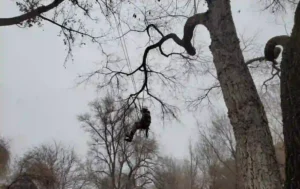
Using climbing spikes on trees being trained damages bark and cambium. Spikes create hundreds of wounds inviting disease. Professional climbers use rope and saddle techniques avoiding spike damage. Never hire services using spikes on living trees being pruned.
Neglecting training for several years allows problems to establish. Three years without training lets competing leaders grow thick. Crossing branches create wounds. Poor structure becomes expensive to correct. Annual attention during the critical 2-5 year window prevents these problems.
Species-Specific Training Considerations
Training principles remain consistent but specific techniques vary by species.
Oaks develop strong central leaders naturally. Training focuses on scaffold spacing and removing lower branches gradually as the tree matures. Oaks tolerate training well and respond predictably to pruning.
Maples vary by type. Red and sugar maples maintain single leaders easily. Silver and Norway maples produce multiple leaders requiring aggressive competitor removal. Japanese maples often grow naturally as multi-stem trees—don’t force single leaders on varieties bred for multi-stem form.
Pines and conifers require minimal training. Remove competing leaders but avoid removing lateral branches. Conifers don’t produce new growth from old wood. Removing branches creates permanent bare areas. Training focuses on leader selection and that’s about it.
Fruit trees follow completely different training systems. Apples and pears train to central leader or modified leader forms. Stone fruits train to open center or vase forms. Fruit tree training prioritizes fruit production and picking access over storm resistance.
Flowering trees like dogwoods, redbuds, and magnolias often develop as multi-stem specimens. Training maintains 2-4 main stems with proper spacing rather than forcing single leaders against their natural form.
Fast-growing species like willows, poplars, and silver maples need more frequent training—sometimes twice annually. They produce excessive growth requiring more regular correction. Slow-growing species like oaks and many evergreens need training only annually or biannually.
How to Train Young Trees for Strong Growth – Seek Professional Help or Use DIY Training
Homeowners can handle basic training on small trees under 10 feet tall. This involves removing small competing leaders, selecting scaffold branches, and removing crossing or damaged growth. Basic hand pruners and loppers provide sufficient tools.
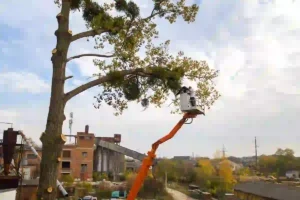
Professional arborists should handle training on larger trees, trees requiring climbing, or situations needing significant structural correction. Professionals have training in tree biology, proper cutting techniques, and can evaluate structural issues homeowners might miss.
The investment in professional training pays off long-term. Spending $400-$800 across a young tree’s first 5 years prevents $2,000-$5,000 in corrective work or removal costs later. Professional training establishes proper structure that lasts the tree’s entire life.
Some situations absolutely require professionals. Trees near power lines. Trees requiring climbing over 10-12 feet. Trees with major structural problems like large co-dominant stems. Complex species like specimen trees or expensive ornamentals. High-value locations where mistakes create significant liability.
Training young trees takes consistent attention across critical early years. The structure you establish now determines the tree’s form, strength, and longevity for its entire life. Invest the time and money during the first 5-8 years. The returns compound for decades as your properly trained trees grow into strong valuable landscape specimens requiring minimal corrective maintenance.