Professional tree trimming breaks down into several distinct techniques. Crown thinning addresses density. Crown reduction handles size problems. Deadwooding removes hazards. Structural pruning shapes young trees. Each one solves different issues and comes with different price tags.
Most people call asking for “tree trimming” without realizing that’s like calling a doctor asking for “medicine.” What kind? For what problem? Trimming branches away from your roof is completely different work than removing dead wood or thinning a dense canopy.
Knowing these differences gets you accurate quotes and prevents paying for work you don’t need. And, using the treetrimmingcostcalculator.com can provide you accurate estimates of what your next tree trimming job will cost.
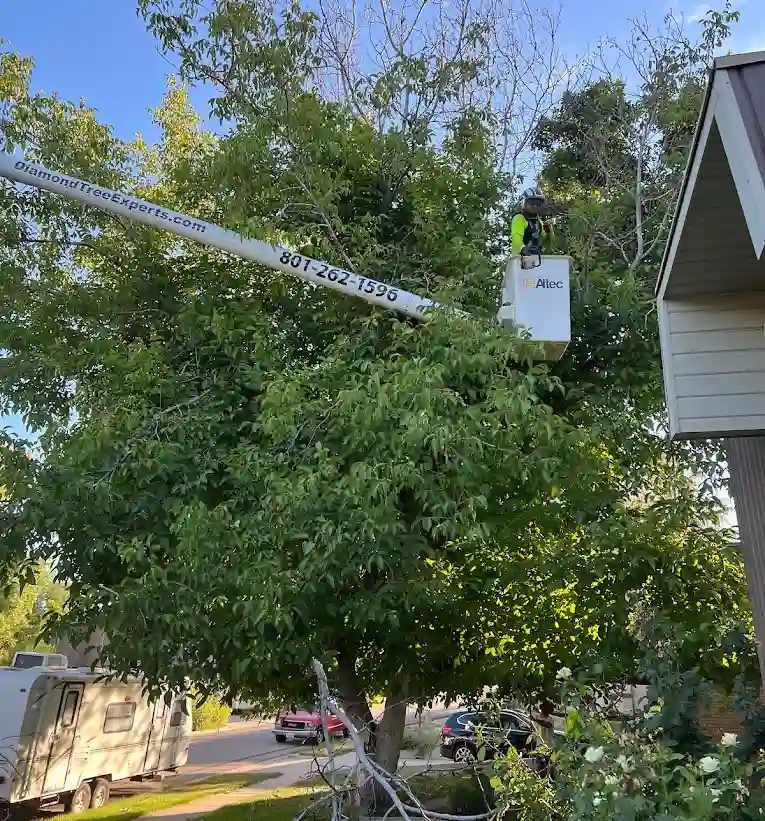
Understanding Types of Tree Trimming Services
Tree services fall into categories based on what gets cut and why. Health-focused trimming removes diseased or dead material. Safety trimming eliminates hazards near buildings or power lines. Aesthetic work shapes trees for appearance. Structural trimming builds proper frameworks in developing trees.
A certified arborist figures out which services your trees actually need. That 5-year-old oak needs structural work to establish good branch architecture. Your mature oak with the super-dense canopy needs thinning. Same species, totally different requirements. Age, location, condition, and what’s around the tree all determine which approach makes sense.
You can handle small pruning yourself—branches under 2 inches you can reach safely from the ground. Everything else needs professionals with proper equipment and training.
Crown Thinning: Selective Branch Removal for Light and Airflow
Crown thinning (pruning) removes specific branches throughout the canopy without changing the tree’s size or shape. Arborists target crossing branches, weak growth, and overly dense areas. This isn’t random cutting, there’s a pattern to it.
The main goal is getting air and light through the canopy. Dense trees trap moisture which fungi love. Leaves stay wet longer after rain because air doesn’t move through. Thinning opens things up so air flows and sunlight reaches interior branches.
Storm resistance improves too. Dense canopies catch wind like sails putting enormous stress on trunks and roots. Proper thinning cuts wind resistance 15-30% without weakening the tree. Thinned trees flex in storms instead of snapping.
Industry standards limit thinning to 10-30% of live canopy in one session. More than that stresses the tree and triggers crazy regrowth that defeats the whole purpose. Oaks, maples, elms—they handle thinning well. Fast growers like poplars need it more often than slow growers.
Expect $300-$800 for average residential trees. Bigger trees needing cranes or extensive climbing run $1,000-$2,000. Most properties need thinning every 3-5 years once you establish a schedule.
Crown Reduction: Decreasing Overall Tree Size
Reduction makes trees smaller by cutting branches back to lateral branches big enough to take over as the new growing point. This is not topping. Topping cuts to stubs and permanently damages trees. Proper reduction cuts to healthy laterals that keep growing naturally.
Trees need reduction when they outgrow their location. Branches rubbing your roof wreck shingles and let pests in. Growth near power lines causes outages and fire hazards. Sometimes trees were planted in the wrong spot and eventually you face reduction or removal—reduction costs less when it’s feasible.
The key is cutting to proper laterals. The remaining branch must be at least one-third the diameter of what you’re removing. Smaller laterals can’t handle the load and die back. Multiple cuts across the canopy maintain natural shape instead of creating weird flat sections.
Most species tolerate 20-30% reduction per session. More than that severely stresses them. Maples and oaks handle it reasonably well. Birches and pines? They often decline after aggressive reduction.
Reduction runs $400-$1,200 for typical trees. Complex jobs near structures or needing specialized equipment hit $1,500-$3,000. When removal isn’t practical because of location or budget, reduction becomes the long-term management strategy.
Deadwooding: Removing Dead and Dying Branches
Deadwooding takes out all dead, diseased, and dying branches. Dead branches fall eventually—sometimes on people, cars, buildings, or power lines. Removing them proactively prevents damage and liability claims.
Disease spreads through dead wood. Fungi, bacteria, insects colonize dead branches then migrate into healthy tissue. Regular deadwood removal slows or stops disease progression depending on what’s causing it. Plus trees just look better without dead branches sticking out everywhere.
You can technically deadwood year-round but late winter works best. Bare branches make dead wood obvious. Trees aren’t actively growing so they heal quickly once spring growth starts. Summer deadwooding works fine but costs more due to higher seasonal demand.
Arborists identify dead branches through multiple signs: no buds, brittle bark, discolored wood underneath, fungal growth, no green cambium layer when you scratch the bark. Dormant winter branches can look dead but aren’t. Professional assessment prevents mistakenly cutting healthy wood.
Partial deadwooding handles accessible branches without major climbing. Complete deadwooding involves climbing the entire tree to remove all dead material regardless of where it is. Properties near structures, play areas, parking lots, sidewalks—these need complete work for liability protection.
Costs range from $200-$600 for minimal dead wood to $800-$1,500 for extensive work requiring crane removal. Emergency cleanup after branches fail runs higher because of immediate response demands.
Structural Pruning: Training Young and Developing Trees
Structural pruning establishes proper branch architecture in trees typically 1-10 years old. This is investment work. Spend money now to prevent expensive problems 10-20 years down the road. Proper structure reduces storm damage, extends lifespan, and cuts future maintenance costs.
Young trees develop predictable structural problems without intervention. Co-dominant stems where two trunks compete create weak unions that split under stress. Narrow-angled branches attach weakly and break under load. Crossing branches rub and create disease entry wounds. Unbalanced weight distribution makes trees unstable.
Structural work addresses these issues while trees are small and fixes are cheap. Removing co-dominant stems at 1-2 inches diameter costs $100-$200. Wait until they’re 12 inches? Now you’re looking at $1,000-$3,000 and wounds that never fully close.
Young trees need work every 1-3 years depending on growth rate and species. Fast growers like maples and ash need more attention. Slow growers like oaks need less frequent visits. Most structural programs run 5-8 years establishing the framework before shifting to maintenance mode.
The math works. Investing $500 across 5 years prevents $3,000-$5,000 in corrective work or removal later. Structurally sound trees handle storms better, develop better form, need less corrective work as they age, and live longer.
Crown Raising: Increasing Clearance Below Trees
Raising removes lower branches to create clearance between the ground and canopy. This solves practical problems—vehicle access, pedestrian clearance, building clearance, mowing under trees, improving visibility at intersections.
Standard clearances vary by use. Sidewalks need 8 feet for pedestrians. Driveways need 12-14 feet for vehicles. Streets need 14-16 feet depending on what drives there. Buildings need 6-10 feet to prevent roof damage and pest access. These measurements run from ground to the lowest remaining branch.
How much you can raise depends on species and total height. General rule caps raising at one-third of total tree height. A 30-foot tree can go to 10 feet safely. More than that stresses the tree and removes too much foliage.
Species matter. Oaks, maples, most hardwoods tolerate significant raising. Pines, spruces, conifers respond poorly—they develop permanently bare lower sections. Dogwoods and redbuds branch naturally low and look weird when raised excessively.
Raising often combines with other work. Raise while thinning. Raise while cleaning the crown. Combined services cost less than separate visits.
Municipal codes frequently mandate specific clearances for street trees. Cities issue violations requiring raising to meet code. You pay for corrections or face fines. Knowing local requirements before trees outgrow clearances prevents forced emergency work.
Raising costs $200-$500 for typical residential trees. Complex situations near structures or requiring traffic control run $600-$1,200.
Crown Cleaning: Comprehensive Canopy Maintenance
Crown cleaning packages everything together—dead wood, diseased branches, broken limbs, weak attachments, crossing branches, water sprouts, suckers. This is comprehensive maintenance covering multiple problems in one service.
What separates cleaning from basic trimming is the systematic approach. Basic trimming might grab obvious dead branches. Crown cleaning inspects the entire tree removing every problem branch regardless of size or location. This means climbing to the top instead of just working from ground or ladder height.
Healthy trees need cleaning every 3-5 years to maintain condition without major corrective work. Neglected trees need heavy initial cleaning then move to regular schedules. Properties with multiple mature trees often clean annually but rotate through trees rather than doing everything at once.
Crown cleaning costs more than single-service work but less than scheduling multiple separate visits. One mobilization handling all issues beats three separate trips for deadwooding, structural correction, and thinning. Average cleaning runs $400-$800. Large mature trees requiring extensive climbing reach $1,000-$1,800.
Health benefits accumulate over time. Regular cleaning prevents small problems from becoming expensive emergencies. Remove crossing branches before they wound each other. Take out weak attachments before they break and tear bark. Catch disease early before it spreads.
Specialty Services for Specific Needs
Beyond standard categories, several specialty services handle unique situations.
Vista pruning selectively removes branches to enhance views without removing entire trees. Arborists evaluate sight lines from specific vantage points then remove minimum branches necessary while maintaining health and appearance. Works great for waterfront properties, mountain homes, anywhere views add property value. Runs $300-$1,000 depending on complexity.
Pollarding is intensive reduction creating formal appearance by cutting to the same points annually. Only specific species tolerate this—willows, lindens, London planes, certain maples. Most species die from pollarding stress. This requires specialized knowledge and annual maintenance commitment. Used for formal gardens and historical properties. Initial work costs $500-$1,500 per tree plus $200-$400 annual maintenance.
Fruit tree pruning follows completely different rules than ornamental work. Goals include maximizing production, maintaining picking height, removing diseased wood, thinning fruit clusters. Stone fruits prune in summer. Pome fruits prune late winter. Wrong timing tanks yields and increases disease risk. Specialists charge $100-$300 per tree annually.
Storm cleanup is emergency work after weather events removing hanging branches, splits, broken limbs threatening immediate damage. Emergency rates apply—expect 50-100% premiums over standard pricing.
Restoration pruning corrects previous improper work or storm damage over multiple years. Topped or severely damaged trees can’t be fixed in one session. Restoration requires 3-5 years gradually rebuilding proper structure. Costs $500-$1,000 annually per tree but saves trees that would otherwise need removal.
Matching Problems to Appropriate Services
What you see determines what you need.
Branches hitting your house or roof—that’s crown reduction or raising depending on where contact occurs. Upper branches need reduction. Lower branches need raising.
Dense canopy blocking sunlight from your yard or windows—crown thinning opens things up without drastically reducing size.
Visible dead branches—deadwooding, especially anything over 2 inches diameter or within falling range of structures, vehicles, or traffic areas. Don’t wait for branches to fall.
Young trees with multiple trunks, narrow branch angles, or lopsided growth—structural pruning immediately. Five-year-old trees cost $150-$300 to fix. Twenty-year-old trees with bad structure run $1,000-$3,000 if you can even correct them at that point.
Low branches blocking driveways, sidewalks, sight lines—crown raising to appropriate clearance.
Trees looking generally messy with various minor issues—crown cleaning handles everything simultaneously instead of piecemeal fixes.
Many trees need multiple services. Dense canopy with dead branches needs thinning and deadwooding. Young trees might need structural work plus raising for clearance. Comprehensive assessment from a certified arborist identifies everything so you can schedule and budget properly.
Why Certified Arborists Matter
ISA certified arborists have credentials requiring extensive knowledge testing and continuing education. This isn’t marketing fluff—certification demonstrates actual knowledge of tree biology, proper techniques, species requirements, and safety standards.
The quality difference shows in the work. Arborists understand proper cut placement. They cut to branch collars promoting healing. Uncertified crews often make flush cuts removing collars or leave excessive stubs. Both cause permanent damage creating disease entry points.
Improper work causes damage that never heals. Topping removes the entire canopy leaving massive wounds that never close and causing weak regrowth. Lion’s tailing removes interior branches leaving weight at branch tips increasing breakage. Over-thinning stresses trees and triggers excessive regrowth. These mistakes come from lack of training.
Insurance matters significantly. Legitimate services carry comprehensive liability and workers comp covering property damage and injuries. Uninsured companies leave you liable for injuries on your property and damage from their work. Always verify insurance.
Questions to ask: Are you ISA certified? What’s your certification number? Do you carry liability insurance and workers comp? Can you provide proof? Will you provide written contracts specifying exact services? Can you provide references?
Warning signs: Offering to top trees. Suspiciously low bids. No insurance documentation. No written contracts. Pushing immediate decisions. Large deposits before work starts. Using climbing spikes on trees being pruned rather than removed.
Certified arborists cost 10-20% more than unqualified services but prevent permanent damage worth thousands in lost property value and future removal costs. The premium buys knowledge preventing expensive mistakes cheap services routinely make.