Table of Contents
Understanding Tree Maintenance Fundamentals
Maintaining the trees on your property is essential for safety, health, and curb appeal. Overgrown branches can pose hazards during storms, potentially causing property damage or injury. Professional Tree Maintenance Services ensure trees thrive while minimizing risks, allowing homeowners and businesses to enjoy lush landscapes without worry.
Tree maintenance services encompass a range of care, including trimming to shape and remove dead wood, and pruning to promote healthy growth by targeting specific branches. Pruning differs from harmful topping, which stubs branches and invites disease; proper pruning enhances structure and vitality. Why is tree pruning important? It improves air circulation, reduces weight on limbs, and prevents storm damage, extending tree lifespan. For safety and longevity, certified arborists are crucial–they use specialized tools and knowledge to avoid mistakes that DIY efforts often make, like improper cuts leading to decay.
Key factors influencing costs include tree size, location, and service type. Smaller trees under 30 feet might cost $300 to $1,000 for basic trimming, according to Angi’s guide, while larger or complex jobs run higher due to equipment needs. Tree Pruning Cost varies by these elements, plus seasonal timing–fall or winter often sees lower rates. When selecting pros, look for Certified Arborist Near Me with credentials and experience to ensure quality work.
This guide covers everything from pruning basics to advanced techniques and cost breakdowns. Start with our free cost calculator for instant, personalized estimates based on your tree details, empowering you to connect with local experts confidently and budget effectively for professional tree care.
Tree Pruning Basics and Best Practices
Tree pruning forms a cornerstone of effective Tree Maintenance Services, helping homeowners maintain healthy landscapes while enhancing property safety and aesthetics. Proper pruning not only shapes trees for better growth but also prevents potential hazards like falling branches. Understanding these basics empowers you to plan routine tree care that aligns with your budget, including considerations for Tree Pruning Cost influenced by timing and tree condition.
Frequency and Timing for Pruning
Pruning frequency depends on tree age, type, and health status, with young trees needing more regular attention to establish strong structures. For instance, mature oaks might require cuts every three to five years, while fruit trees benefit from annual sessions to boost yields. The dormant season, typically late fall or winter, stands out as ideal because it minimizes stress, reduces sap flow risks, and allows quicker recovery without active growth interference. Pruning during this period also lowers Tree Pruning Cost over time by preventing disease outbreaks that demand expensive treatments later. Always assess tree-specific needs; consult professional pruning schedules to avoid over-pruning, which can weaken vitality.
To guide your planning, the following table outlines recommended intervals for common species:
| Tree Type | Frequency | Best Season | Key Benefits |
|---|---|---|---|
| Oak | Every 3-5 years | Spring/Early Summer | Reduces disease risk, promotes strong growth |
| Maple | Every 2-4 years | Late Fall/Dormant | Prevents sap bleeding, enhances structure |
| Pine | Annually or as needed | Late Winter | Controls shape, removes deadwood safely |
| Fruit Trees | Annually | Late Winter/Early Spring | Boosts fruit production, maintains health |
| Evergreens | Every 2-3 years | Spring | Improves airflow, reduces pest issues |
| Young Trees | Annually | Any Season (Light) | Establishes strong form, prevents future problems |
| Mature Trees | Every 5-7 years | Dormant Season | Maintains safety, extends lifespan |
| Ornamental | Every 1-2 years | Post-Bloom | Preserves aesthetics, supports blooming cycles |
| Hazardous/Overgrown | As needed (Emergency) | Varies | Addresses immediate risks |
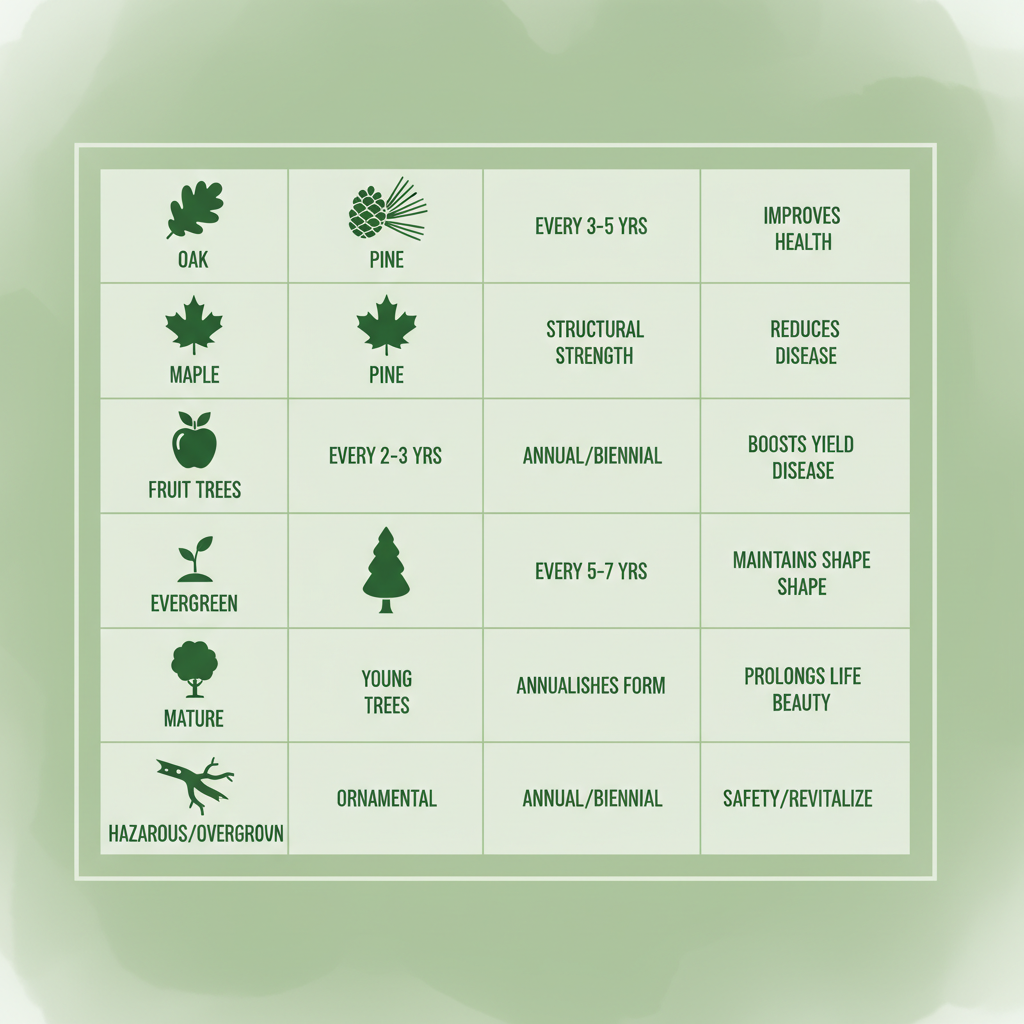
Pruning frequency recommendations for different tree species and types
This comparison highlights how tailored timing supports long-term tree health, drawing from arborist guidelines that emphasize site-specific adjustments.
Importance of Proper Pruning Techniques
Correct pruning techniques foster vigorous growth, improve structural integrity, and ward off diseases by enhancing airflow and sunlight penetration. Selective removal of dead, diseased, or crossing branches redirects energy to healthy limbs, resulting in fuller canopies and reduced pest habitats. In contrast, harmful methods like topping–making severe, flat cuts across major branches–starve the tree of nutrients, invite decay, and create weak regrowth prone to breakage. Such practices not only shorten tree lifespan but also spike future Tree Pruning Cost through repairs or removals. Homeowners should prioritize clean, angled cuts just outside the branch collar to promote natural healing and avoid stubs that harbor pathogens. Basic safety tips include using sharp tools and wearing protective gear when observing professional work.
Choosing the right approach matters; the table below contrasts key methods to underscore professional necessity:
| Method | Risks/Benefits | Cost Impact | Recommended Use |
|---|---|---|---|
| Proper Pruning | Benefits: Healthier growth, disease prevention; Low risk | Lower long-term maintenance | All healthy trees for routine care |
| Topping | Risks: Structural weakness, decay entry; No benefits | Higher due to regrowth issues | Never; avoid at all costs |
| Stub Cutting | Risks: Disease invitation, poor healing; Minimal benefit | Increases repair expenses | Rarely; only if unavoidable |
| Selective Thinning | Benefits: Better light/airflow; Low risk | Cost-effective prevention | Overcrowded or shaded areas |
As shown, proper techniques save money and extend tree life, reinforcing the value of local arborist expertise over quick fixes. Regular application prevents costly emergencies.
Selecting Reliable Tree Service Providers
Choosing dependable providers ensures pruning aligns with best practices, safeguarding your investment in tree care. Look for companies with ISA certifications, verifying their adherence to industry standards through resources like HomeAdvisor’s arborist guide, which outlines verification steps and notes average consultation fees around $100-$200. Insurance coverage protects against accidents, while positive reviews on platforms like Bark reveal service quality and typical fees–ranging from $200 for small jobs to $1,000+ for complex ones–tied to frequency and scale. Request references to gauge reliability and discuss your needs upfront for accurate Tree Pruning Cost estimates.
Key criteria include:
- Valid certifications and bonding for accountability.
- Experience with your tree species and local regulations.
- Transparent pricing without hidden fees.
- Commitment to cleanup and safety protocols.
Prioritizing a Certified Arborist Near Me builds confidence; their assessments prevent overpayment by tailoring services to actual requirements, ultimately lowering long-term costs through proactive maintenance.
Exploring Pruning Costs and Service Details
Understanding the financial side of Tree Maintenance Services is essential for homeowners planning tree care. Pruning costs vary widely based on several key elements, helping you set realistic expectations and budget effectively for professional help. This exploration breaks down the main influences on Tree Pruning Cost, average ranges for different types, and how trimming differs from pruning to guide your decisions.
Factors Influencing Pruning Expenses
Several critical factors determine pruning budget factors and overall arborist service fees. Tree size stands out as a primary driver; smaller trees under 30 feet require less time and equipment, keeping costs lower, while larger ones over 60 feet demand specialized tools like cranes, inflating expenses. For instance, a 40-foot oak might cost $600 due to moderate height and easy access in a backyard setting.
Species also plays a significant role in tree care expenses. Hardwoods like oaks are generally more affordable to prune because of their sturdy branches, whereas softwoods such as maples can incur higher fees due to sap management and delicate structures that risk damage during cuts. Site access further complicates pricing; urban lots with power lines or tight spaces add 20-50% surcharges for safety measures and extended labor.
- Tree Size and Height: Directly correlates with labor hours; expect hourly rates of $150-$450 from certified professionals.
- Species Characteristics: Influences tool needs and risk levels.
- Location and Access: Poor access raises costs through additional equipment.
Regional variations, as noted in standard arborist guides, mean costs in urban areas like California can exceed national averages by 15-20%. Planning around these helps avoid surprises and ensures value-driven choices over low bids.
The following table provides a pruning cost comparison by tree size and type, based on national averages to aid budgeting:
| Service Type | Small Tree (<30ft) | Medium Tree (30-60ft) | Large Tree (>60ft) | Additional Factors |
|---|---|---|---|---|
| Basic Pruning | $200-$400 | $400-$800 (Height and access fees) | Oak Species: Lower due to hardy nature | |
| Deep Root Pruning | $300-$600 | $600-$1,200 (Root exposure complexity) | Maple Species: Higher for sap management | |
| Crown Thinning | $250-$500 | $500-$1,000 (Density removal effort) | Site Access Poor: +20-50% surcharge | |
| Emergency Pruning | $400-$700 | $700-$1,400 (Urgency premium) | Cleanup Included: Standard in quotes | |
| Stump Removal Add-on | $100-$300 extra | $100-$300 extra | Recommend using site calculator for precise estimates |
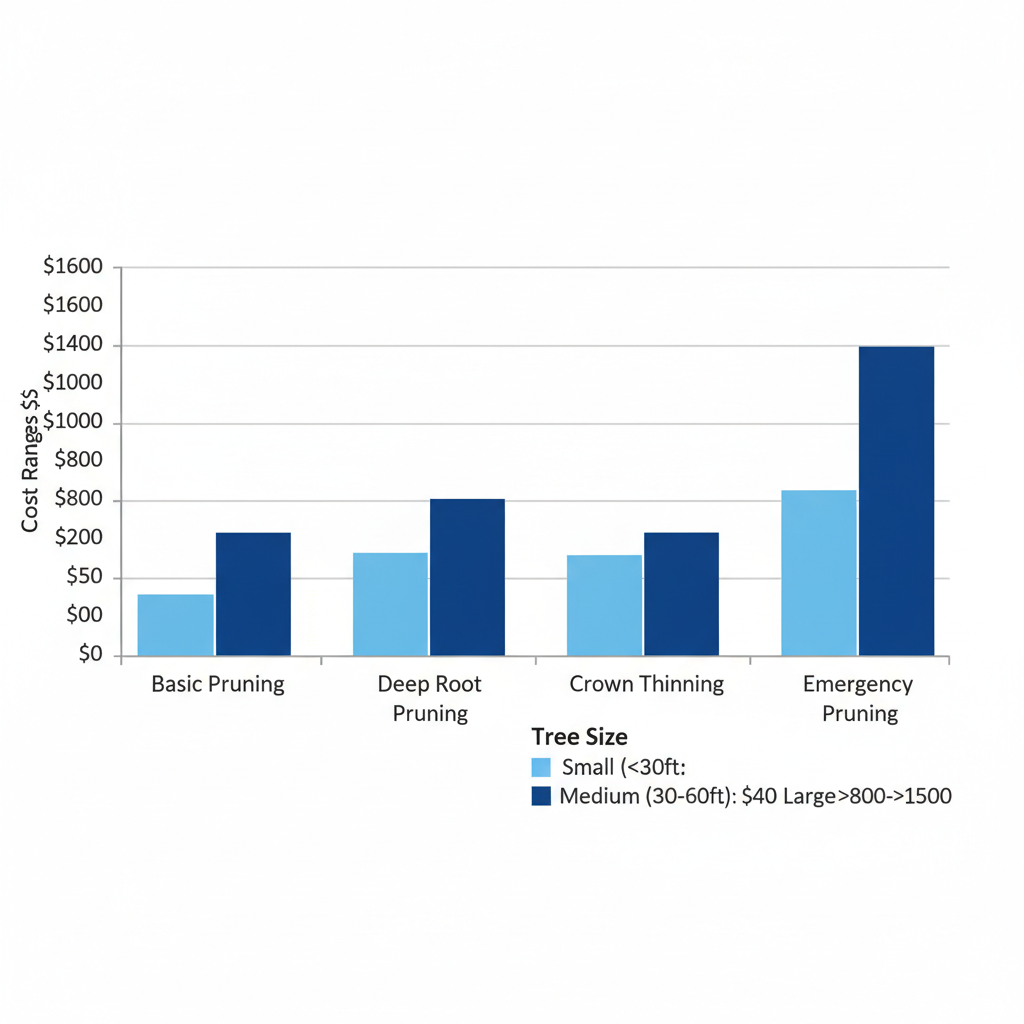
Pruning cost comparison by tree size and service type
Average Costs for Various Pruning Types
When budgeting for Tree Maintenance Services, knowing average costs for pruning types ensures accurate planning. Standard pruning, which involves selective branch removal for shape and health, typically ranges from $200 to $1,500 depending on tree scale, with most jobs falling in the $400-$800 bracket for medium trees. These services often include debris cleanup and a basic inspection, adding value without extra charges.
Deep root pruning addresses underground issues like compaction or transplant preparation, costing $300-$2,500. For small trees, expect $300-$600 as it involves minimal excavation, but larger specimens require specialized tools, pushing prices to $1,200-$2,500. Inclusions here feature root barriers and soil backfill, essential for preventing regrowth problems, with arborist service fees reflecting the expertise needed–around $150-$450 per hour per industry standards.
Specialty pruning, such as crown raising for clearance or deadwood removal, varies from $250-$2,000. These focus on safety and aesthetics, with cleanup always standard to leave properties tidy. Factors like location elevate tree care expenses; coastal regions might add 10-15% for humidity-related complexities. Overall, these ranges, drawn from verified arborist cost data, underscore the importance of consulting a Certified Arborist Near Me for tailored quotes that balance cost and quality.
Homeowners can save by bundling services or opting for annual plans, but always prioritize inclusions like consultations to confirm scope. This approach turns potential Tree Pruning Cost uncertainties into manageable investments in property upkeep.
Differences in Trimming vs. Pruning Costs
distinguishing between trimming and pruning clarifies service choices and their pricing impacts within Tree Maintenance Services. Trimming focuses on aesthetic light cuts, like shaping hedges or removing minor overgrowth, while pruning targets health through selective, structural removals to prevent disease or hazards. This difference affects costs significantly; trimming jobs average $150-$500 for quick work, whereas pruning ranges $200-$2,000 due to deeper assessments and risks.
Trimming suits quick visual enhancements, often cheaper because it uses basic tools and less time–ideal for routine upkeep. Pruning, however, demands certified expertise for precise cuts that promote growth, justifying higher arborist service fees. For example, trimming a small shrub might cost $150 including cleanup, but pruning a mature tree for structural integrity could reach $800, reflecting the added labor and safety protocols.
The table below outlines key differences:
| Aspect | Trimming | Pruning | Cost Difference | When to Choose |
|---|---|---|---|---|
| Primary Focus | Aesthetics and light shaping | Health, structure, and safety | Trimming: 20-40% lower | Routine visual maintenance |
| Technique | Surface-level cuts | Selective, deep branch removal | Pruning higher due to expertise | Disease prevention or storm prep |
| Scope | Overgrowth and minor branches | Deadwood, crossing limbs | $100-$500 variance typical | Long-term tree vitality |
| Inclusions | Basic cleanup | Inspection, debris removal | Similar add-ons | When certified diagnosis needed |
| Average Duration | 1-2 hours | 2-6 hours | Time drives pruning premium | Professional hazard assessment |
Post-table, consider how these distinctions influence tree care expenses; always obtain multiple quotes from at least three providers to compare inclusions and avoid low-bid pitfalls. Verify licensing and insurance, as recommended in arborist guides, to ensure reliable service. Strategies like seasonal timing can reduce costs by 10-20%, empowering you to invest wisely in Certified Arborist Near Me for enduring results rather than short-term savings.
Implementing Effective Tree Maintenance Plans
Implementing Tree Maintenance Services requires a structured approach to connect with qualified professionals and ensure smooth execution. Start by identifying reliable local tree experts through targeted searches, then move to scheduling and preparation for optimal results.
Finding and Verifying Local Arborists
Begin your search for a Certified Arborist Near Me using online directories like the International Society of Arboriculture (ISA) website, which lists certified professionals by location. Community referrals from neighbors or local landscaping groups can also point to trusted providers. For broader reach, check platforms such as Angi or HomeAdvisor, filtering for ISA certification and positive reviews.
Once you have potential candidates, verify their credentials through a step-by-step process. First, confirm ISA certification via the official lookup tool on treesaregood.org, ensuring the arborist holds an active credential with ongoing education requirements. Next, check for state or local licenses through your area’s regulatory board, as many regions mandate bonding and insurance for tree work. Request proof of liability coverage to protect against property damage, and contact at least three references for insights on past performance. This diligence safeguards against unqualified operators and aligns with industry best practices for safety.
The following table compares key aspects of certified arborists versus general tree services to highlight qualification differences:
| Service Aspect | Certified Arborist | General Tree Service | Cost Range | Qualification Level |
|---|---|---|---|---|
| Certification | ISA Certified, Ongoing Education | Basic Licensing, Variable Training | $75-$150/hr | Higher Expertise |
| Consultation Depth | Comprehensive Assessment, Tree Health Focus | Basic Inspection | $50-$200 | Specialized |
| Pruning Techniques | ANSI Standards, Precise Cuts | Standard Methods, May Include Topping | $300-$1,000 | Safer, Premium |
| Emergency Response | 24/7 Availability, Risk Assessment | Limited Hours | $500+ | Faster, Reliable |
| Services Offered | Full Spectrum: Pruning, Diagnosis, Removal | Trimming, Basic Care | Varies | Broader Scope |
| Insurance/Liability | Full Coverage, Bonded | Basic or None | Extra for gaps | Protected Projects |
| Verification Process | ISA Lookup, References | Reviews, Word-of-Mouth | Saves disputes | Easier Vetting |
Certified arborists adhere to industry standards per ISA, offering superior expertise for complex jobs, while general services may suffice for simple tasks but risk quality issues. Always verify via official directories for safety, recommending certified options for pruning projects to ensure long-term tree health.
Scheduling Consultations and Services
After verifying providers, initiate contact via phone or online forms for professional tree consultations. Prepare by noting tree details like size, location, and issues to streamline the discussion. Most certified arborists respond within 24-48 hours, per hiring insights from Angi, which emphasizes prompt communication for efficient planning.
The consultation process starts with an initial call to discuss needs, followed by an on-site assessment. Expect the arborist to evaluate tree condition, access challenges, and recommend services like pruning or removal. Quotes typically factor in Tree Pruning Cost based on tree diameter, height, and complexity–Angi reports averages of $300-$1,000 for standard jobs, with free initial visits common to build trust.
For scheduling, distinguish between standard and urgent arborist scheduling needs. Standard pruning books 1-2 weeks out, allowing time for preparation, while emergencies like storm damage prioritize faster slots at a premium. Confirm timelines, payment terms, and any deposits during the call. Use written agreements outlining scope, costs, and timelines to avoid misunderstandings. This pathway lowers barriers, with many offering same-week availability for routine Tree Maintenance Services.
To illustrate service timelines, consider this comparison table:
| Service Type | Response Time | Cost Add-on | Preparation Needs |
|---|---|---|---|
| Initial Consultation | Same day to 1 week | Free to $100 | Site photos, tree measurements |
| Standard Pruning | 1-2 weeks | None | Clear access path, mark trees |
| Crown Reduction | 2-4 weeks | 10-20% premium | Secure pets, notify neighbors |
| Emergency Removal | 24-48 hours | 20-50% premium | Cordon off area, remove hazards |
| Full Assessment | 3-5 days | Included in quote | Provide property diagram |
Urgency impacts costs and readiness, with Angi noting that advance planning minimizes add-ons and ensures quality execution for all projects.
Preparing for Pruning Projects
Proper preparation enhances safety and efficiency for pruning services. Start with a site readiness checklist: Clear the work area of obstacles like furniture or vehicles within a 20-foot radius, especially on urban lots where access challenges arise. Mark affected trees with flags or tape to guide the crew, and trim back nearby vegetation to prevent interference.
Safety measures are paramount–relocate pets and children indoors during operations, and inform neighbors of potential noise or debris. Ensure stable footing for equipment by watering dry soil if needed, and secure loose items like lawn ornaments. Document the site with photos before work begins to track changes and support any insurance claims.
Post-service care maximizes outcomes: Rake up debris promptly to avoid hazards, and monitor trees for signs of stress like wilting leaves, applying mulch if recommended. Water deeply in the following weeks to aid recovery, particularly in dry seasons. Follow up with the arborist after 4-6 weeks for a health check, adjusting future Tree Maintenance Services as needed. This proactive approach, emphasizing safety first, reduces intimidation and ensures lasting benefits from professional interventions.
(Word count: 532)
Advanced Tree Care Techniques and Considerations
Advanced Tree Maintenance Services elevate basic pruning to specialized tree care that addresses complex growth patterns and environmental challenges. These methods ensure long-term health and safety, often requiring a Certified Arborist Near Me for precise execution. Understanding these techniques helps homeowners anticipate Tree Pruning Cost variations based on species and tools.
Species-Specific Pruning Approaches
Tailored pruning techniques vary by tree type to accommodate unique structures and vulnerabilities. For hardwoods like oaks, crown reduction thins the canopy to reduce wind resistance and promote stability. Conifers such as pines benefit from deadwood removal to prevent disease spread, while ornamentals like fruit trees use espalier pruning to enhance fruit yield and shape. Applications include urban settings where space limits growth, and tips involve timing cuts to minimize sap loss in maples.
The following table compares advanced pruning techniques by tree species, highlighting customization for optimal care:
| Tree Species | Technique | Tools Needed | Risk Level | Cost Impact |
|---|---|---|---|---|
| Oak | Crown Reduction | Pruning Saws, Ladders | Medium | $400-$900 (Durable wood increases labor) |
| Maple | Selective Thinning | Pole Pruners, Harnesses | Low | $300-$700 (Sap flow timing key) |
| Pine | Deadwood Removal | Climbing Gear, Ropes | High (Needles) | $500-$1,200 (Height adds complexity) |
| Fruit Trees | Espalier Pruning | Hand Shears, Supports | Low | $200-$500 (Annual for yield) |
| Palms | Frond Trimming | Pole Saws, Platforms | Medium | $250-$600 (Debris volume high) |
| Evergreens | Shearing | Electric Trimmers | Low | $300-$800 (Shape maintenance) |
| Hazelnut | Coppicing | Loppers, Mulch | Medium | $350-$750 (Regrowth management) |
This customization underscores the need to consult experts when species-specific risks elevate, ensuring professional assessment for safe implementation.
Safety and Compliance in Advanced Services
Safety protocols are paramount in advanced arborist methods, adhering to ANSI A300 standards for pruning and A10 for equipment. Personal protective equipment (PPE) like helmets, harnesses, and chainsaw chaps mitigates falls and cuts, while compliance with local permits prevents fines for large-scale work. Hazard assessments identify unstable branches, and training ensures proper rigging techniques.
Key compliance aspects are outlined below:
| Aspect | Compliant | Non-Compliant | Consequence | Mitigation |
|---|---|---|---|---|
| PPE Usage | Full ANSI-approved gear | Inadequate helmet/gloves | Severe injury or death | Regular inspections and training |
| Equipment Standards | Certified tools inspected | Worn-out saws/ladders | Equipment failure | Annual certifications |
| Permit Acquisition | Obtained for large trees | Work without approval | Legal fines, project halt | Pre-job regulatory checks |
| Worker Training | ISA-certified arborists | Untrained personnel | Inefficient, risky cuts | Ongoing education programs |
Non-compliance heightens risks, so always hire certified professionals to safeguard property and workers.
Integrating Technology in Tree Maintenance
Modern tools transform tech-enhanced pruning, offering precision in assessments and planning. Drones conduct aerial inspections to detect crown decay without ladders, ideal for tall pines in urban areas. GIS mapping software visualizes root zones and growth projections, integrating with site calculators for accurate Tree Pruning Cost estimates. Benefits include reduced labor costs through targeted cuts and enhanced safety by minimizing on-site time.
For instance, drone use in urban pruning identified hidden fractures in oaks, averting potential failures. These innovations control expenses, with Angi data showing tech-assisted services 20-30% more efficient for complex projects, justifying investment in professional oversight.
Common Tree Maintenance Questions Answered
For effective Tree Maintenance Services, we answer key questions on pruning and care to help you decide confidently.
How often should trees be pruned? Trees typically need pruning every 3-5 years, depending on species and health. Regular maintenance prevents overgrowth and hazards. Use our calculator for personalized timing.
When is the best time to prune trees? Late winter or early spring, before new growth, is ideal for most species. Avoid summer to prevent disease. Consult a local expert for specifics.
Why is tree pruning important? Pruning promotes healthy growth, removes dead branches, and reduces storm risks. It enhances safety and aesthetics around your property.
What is the average cost of professional tree pruning? According to the Bark Tree Surgeon Guide, Tree Pruning Cost ranges from $150-$800, based on tree size. Factors like access add to the total. Get a free estimate via our tool.
What is the difference between tree trimming and pruning? Trimming shapes for appearance, while pruning focuses on health and structure removal. Both are essential, but pruning prioritizes safety.
Where can I find a Certified Arborist Near Me? Search certified professionals through our network for verified experts. They ensure safe, compliant work. Contact for a consultation today.
What is the difference between tree topping and pruning? Topping severely cuts tops, harming trees, while proper pruning selectively thins for health. Always choose certified arborists to avoid damage.
Key Takeaways for Effective Tree Maintenance
Effective Tree Maintenance Services ensure vibrant, safe landscapes while minimizing risks and expenses. Regular professional pruning enhances tree health, prevents hazards, and boosts property value. Understanding Tree Pruning Cost factors like size and complexity helps budget wisely, and selecting a Certified Arborist Near Me guarantees expert care.
Timely services deliver safety and long-term savings by avoiding costly emergencies. Use our free calculator for instant estimates, then connect with local pros for personalized quotes.
With these insights, secure your tree’s health today by connecting with a certified arborist.